MW
5,135.9 g/mol
Purity
>99%
Growth Hormone Axis
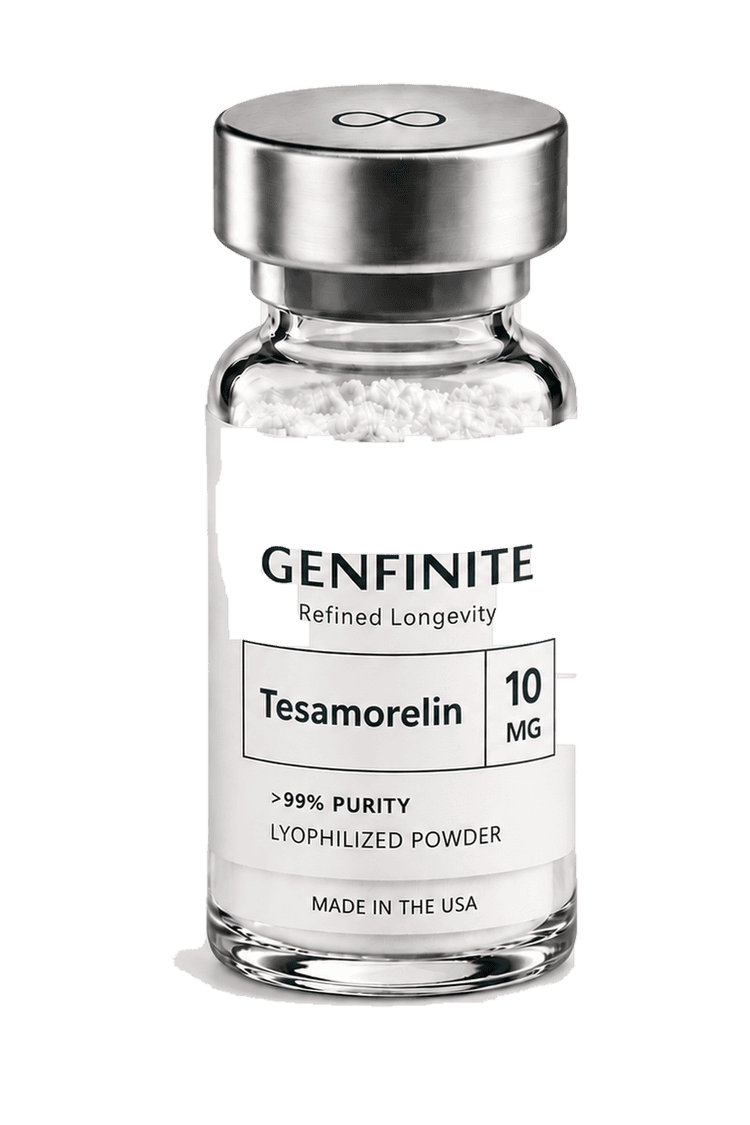
TESAMORELIN
GHRH Analog — GRF(1-44)
Synthetic analog of growth-hormone-releasing hormone (GHRH), stabilized with an N-terminal trans-3-hexenoic acid modification
$100
Per vial · Research use only · COA available
Compound Profile
| Appearance | Lyophilized white powder |
| Molecular Weight | 5,135.9 g/mol |
| Amino Acids | 44 |
| Dosage | 10 mg |
| Volume | 3 mL |
| Solubility | Bacteriostatic water |
| Purity | ≥98% (HPLC-UV-MS verified) |
| Storage | −20°C long-term · 4°C short-term · Protect from light |
COA, sterility, endotoxin, and heavy metal test results available upon request.
For Research Use Only. This product is not for human consumption, clinical use, or veterinary use. Must be 21+ to purchase. Not evaluated or approved by the FDA for any therapeutic use. Introduction into humans or animals is strictly prohibited by law.
Overview
About TESAMORELIN
Tesamorelin is a synthetic analog of human growth-hormone-releasing hormone (GHRH), built on the GRF(1-44) backbone with an added trans-3-hexenoic acid group at the N-terminus for enhanced stability against enzymatic degradation. It is one of the most extensively studied GHRH analogs, examined for its ability to restore pulsatile growth hormone secretion and its downstream effects on visceral fat and IGF-1 levels.
Mechanism of Action
How It Works
Tesamorelin binds the GHRH receptor on pituitary somatotrophs, stimulating cAMP-dependent synthesis and pulsatile release of endogenous growth hormone. Because it acts upstream at the natural GHRH receptor rather than supplying exogenous GH directly, research models report GH release that preserves the body's normal pulsatile secretion pattern and feedback regulation, distinguishing it from direct GH administration.
Scientific Literature
Research Highlights
GHRH receptor agonism — stimulates endogenous pulsatile GH release from the pituitary
Extensively studied for reduction of visceral adipose tissue in body-composition research
IGF-1 elevation studied downstream of pituitary GH release
N-terminal stabilization improves resistance to enzymatic degradation versus native GHRH
Preserves natural feedback regulation of the GH axis relative to direct GH administration
Studied in research contexts involving lipodystrophy and metabolic body-composition change
Reference GHRH analog used in comparative growth-hormone-axis research
Research Disclaimer: All research highlights are derived from published preclinical, in vitro, and animal studies. Results observed in laboratory models may not translate to human outcomes. Genfinite makes no claims regarding therapeutic efficacy. All products are sold strictly for scientific research purposes only.
Handling
Storage & Reconstitution
Dry Storage
Store lyophilized powder at −20°C, away from light and moisture. Do not open until ready to use. Shelf life is significantly extended by proper dry storage.
Reconstitution
Reconstitute using Bacteriostatic water. Add solvent slowly to the side of the vial and allow to dissolve gently. Do not shake vigorously.
Post-Reconstitution
Store reconstituted solution refrigerated at 4°C. Use within your laboratory's established timeframe. Do not refreeze after reconstitution.