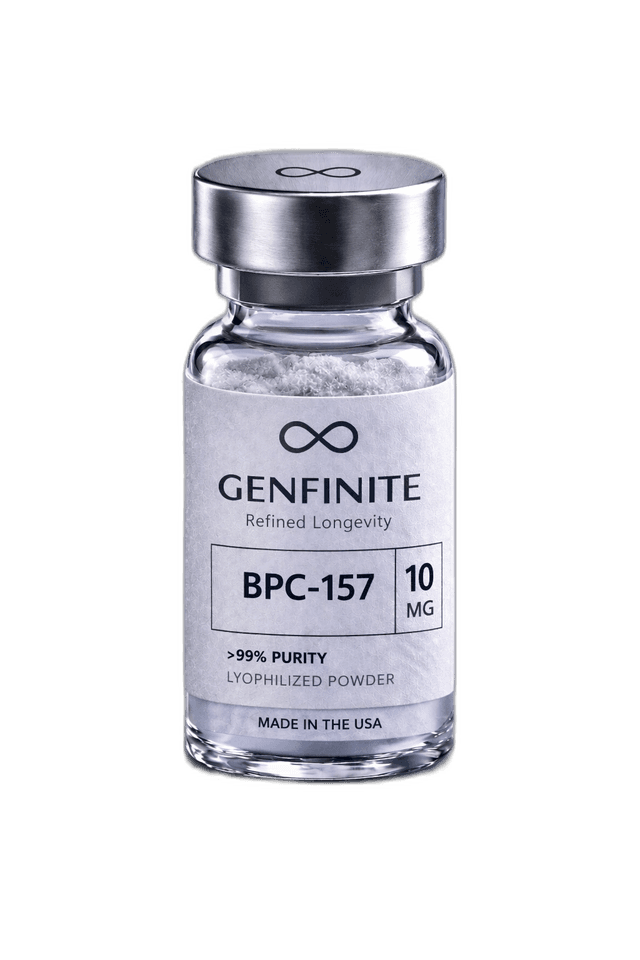
BPC-157 — Body Protective Compound 157 — is a synthetic pentadecapeptide composed of 15 amino acids, originally isolated as a partial sequence of a protein found in human gastric juice. Since its initial characterization in the 1990s, it has become one of the most extensively studied peptides in preclinical regenerative research, examined across a range of tissue types, injury models, and biological systems. This article summarizes the key findings from peer-reviewed literature on its mechanisms and biological activity.
Origin and Structure
BPC-157 (Gly-Glu-Pro-Pro-Pro-Gly-Lys-Pro-Ala-Asp-Asp-Ala-Gly-Leu-Val) was first described by Sikirić and colleagues at the University of Zagreb School of Medicine. It is a stable gastric pentadecapeptide fragment that does not occur freely in nature but is derived from the BPC protein found in human gastric juice. Its stability in various biological environments — including acidic conditions — has made it a practical subject for preclinical study.
Structurally, BPC-157 lacks disulfide bonds, which contributes to its stability. It resists degradation in the presence of human gastric juice and maintains biological activity across diverse experimental conditions, including oral, parenteral, and local administration routes.
Tendon and Connective Tissue Repair
One of the most replicated findings in BPC-157 research involves its effects on tendon and ligament healing. Chang and colleagues (2011) demonstrated that BPC-157 significantly accelerated the healing of transected Achilles tendons in rats, with histological evidence of improved tendon fiber organization and increased collagen content compared to controls.
A key proposed mechanism involves the upregulation of growth hormone receptor (GHR) expression in tendon fibroblasts. Krivic et al. (2006) showed that BPC-157 treatment increased GHR expression in cultured tendon fibroblasts, suggesting that part of its regenerative effect may be mediated through enhanced sensitivity to endogenous growth hormone signaling rather than direct mitogenic activity.
Studies involving muscle tears, ligament injuries, and bone repair have yielded consistent results — BPC-157 treated groups typically show faster recovery, improved biomechanical parameters, and reduced fibrosis relative to control groups in rodent models.
Gastrointestinal Cytoprotection
The gastric origin of BPC-157 aligns with a substantial body of research documenting its cytoprotective effects in gastrointestinal tissue. Multiple studies by Sikirić's group have demonstrated that BPC-157 promotes healing in models of gastric ulcer, duodenal ulcer, inflammatory bowel disease, and intestinal fistula.
In a colitis model, Sikirić et al. (1999) showed that BPC-157 significantly reduced macroscopic and microscopic damage scores, inflammatory infiltration, and oxidative stress markers in colon tissue. The authors attributed this in part to modulation of the nitric oxide system.
Further work identified effects on intestinal anastomosis healing — a clinically relevant outcome — where BPC-157 treated rats showed improved anastomotic strength and reduced leakage rates in standardized surgical models.
Nitric Oxide System Modulation
A recurring theme in BPC-157 mechanistic research is its interaction with the nitric oxide (NO) system. Seiwerth et al. (2014) summarized evidence suggesting BPC-157 can both upregulate endothelial nitric oxide synthase (eNOS) activity and modulate NO-related pathways in a context-dependent manner — supporting vascular tone and blood flow to healing tissue while limiting the damaging effects of excessive NO production in inflammatory states.
This dual modulation may explain the peptide's apparent ability to promote healing across diverse tissue types — from gastrointestinal mucosa to skeletal muscle — by improving local perfusion and reducing oxidative damage simultaneously.
Central Nervous System and Gut-Brain Axis
Preclinical evidence suggests BPC-157 activity extends to the central nervous system, likely through gut-brain axis pathways. Sikirić et al. (2016) reviewed data showing BPC-157 influences dopamine and serotonin neurotransmitter systems, with observed behavioral effects in rodent models of depression, anxiety, and addiction.
Of particular interest is research suggesting BPC-157 may counteract the effects of neurotoxic agents, including alcohol and NSAIDs, at the level of the gastrointestinal-CNS interface. These findings position it as a candidate of interest in neurological recovery research, though human data remains unavailable.
Research Limitations
The current literature on BPC-157 is almost entirely preclinical — conducted in rodent models with no published randomized controlled trials in humans as of this writing. While the consistency of findings across laboratories and models is notable, the translation of these results to human physiology cannot be assumed.
Additionally, the majority of published research has originated from a small number of research groups, and independent replication across diverse institutions remains limited. These constraints are important to acknowledge when interpreting the existing data.
Research Disclaimer: This article is intended for educational and research purposes only. All findings referenced are from published preclinical, in vitro, or animal studies. Results observed in laboratory models may not translate to human outcomes. Nothing in this article constitutes medical advice. Genfinite products are sold strictly for scientific research use only and are not intended for human consumption.
References
- 1.Sikirić P, Seiwerth S, Rucman R, et al. Stable gastric pentadecapeptide BPC 157: novel therapy in gastrointestinal tract. Current Pharmaceutical Design. 2011. DOI: 10.2174/138161211798109002 PubMed: 21548886
- 2.Chang CH, Tsai WC, Lin MS, Hsu YH, Pang JH. The promoting effect of pentadecapeptide BPC 157 on tendon healing involves tendon outgrowth, cell survival, and cell migration. Journal of Applied Physiology. 2011. DOI: 10.1152/japplphysiol.00945.2010 PubMed: 21030672
- 3.Krivic A, Anic T, Seiwerth S, Huljev D, Sikiric P. Achilles detachment in rat and stable gastric pentadecapeptide BPC 157: Promoted tendon-to-bone healing and opposed corticosteroid aggravation. Journal of Orthopaedic Research. 2006. DOI: 10.1002/jor.20172 PubMed: 16779832
- 4.Sikirić P, Seiwerth S, Grabarević Z, et al. Cytoprotective effect of BPC 157, a new stable gastric pentadecapeptide, on various lesions of the digestive system. Life Sciences. 1994. PubMed: 8170155
- 5.Seiwerth S, Rucman R, Turkovic B, et al. BPC 157 and Standard Angiotherapy. Current Pharmaceutical Design. 2014. DOI: 10.2174/1381612820666140130205250 PubMed: 24484000
- 6.Sikirić P, Seiwerth S, Rucman R, et al. Brain-gut Axis and Pentadecapeptide BPC 157: Theoretical and Practical Implications. Current Neuropharmacology. 2016. DOI: 10.2174/1570159X13666150612094624 PubMed: 26022453