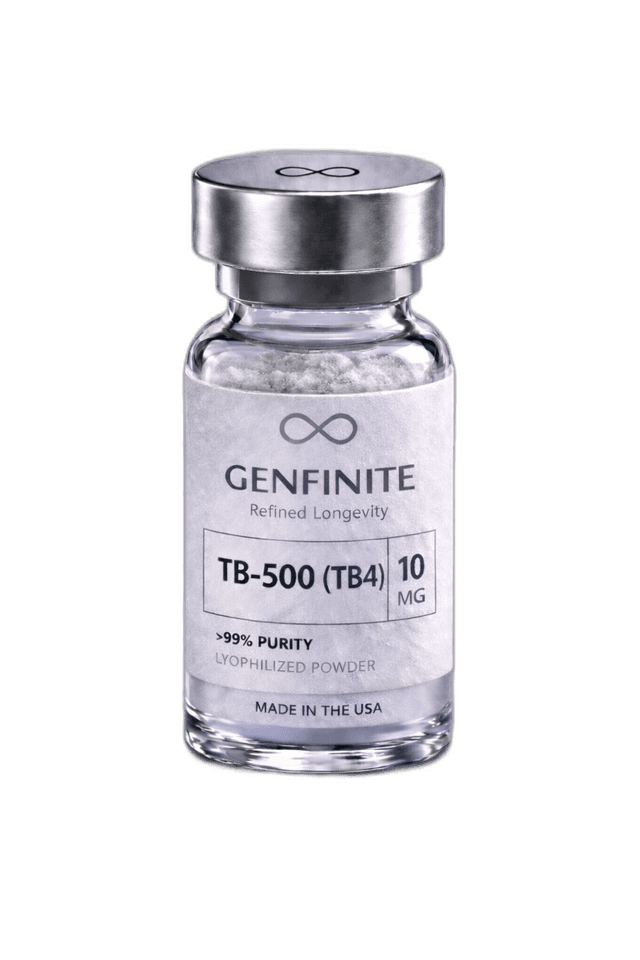
A common source of confusion in peptide research literature is the interchangeable use of 'TB-500' and 'Thymosin Beta-4 (Tβ4).' They are not the same compound. TB-500 is a synthetic peptide corresponding to the actin-binding domain of Tβ4 — a specific 17 amino acid sequence (amino acids 17–23 of the full 43 amino acid protein) that is believed to account for much of Tβ4's regenerative and anti-inflammatory activity. Understanding this distinction is essential for interpreting the research accurately.
Thymosin Beta-4: The Parent Protein
Thymosin Beta-4 is a naturally occurring 43 amino acid protein encoded by the TMSB4X gene. It was originally isolated from thymic tissue as part of the thymosin fraction in the 1960s and 1970s, though subsequent research established that it is ubiquitously expressed — found in virtually all nucleated mammalian cells and at high concentrations in platelets and wound fluid.
Tβ4's primary biological role involves actin sequestration. It binds monomeric G-actin in a 1:1 complex, regulating the pool of actin available for polymerization into F-actin filaments. This function places Tβ4 at the center of cell motility, wound healing, and cytoskeletal dynamics.
The Actin-Binding Domain: TB-500
Within the Tβ4 sequence, the segment Ac-LKKTETQ (positions 17–23, corresponding to the actin-binding domain) has been identified as the biologically active core responsible for most of the protein's regenerative effects. Goldstein et al. (2005) demonstrated that this fragment retains the ability to promote wound healing, angiogenesis, and anti-inflammatory activity in animal models, comparable to full-length Tβ4.
This fragment — marketed and studied as TB-500 — offers the advantage of a smaller molecular weight (approximately 1,000 Da versus 4,963 Da for full Tβ4), which may affect distribution and tissue penetration characteristics. The synthetic peptide is typically produced as a lyophilized powder for research use.
Wound Healing and Tissue Repair
The most replicated finding in Tβ4/TB-500 research involves acceleration of wound healing. Philp et al. (2004) demonstrated that Tβ4 significantly accelerated full-thickness dermal wound closure in db/db diabetic mice — a model of impaired healing — through promotion of keratinocyte migration and re-epithelialization.
Smart et al. (2007) extended this work to cardiac tissue, demonstrating that Tβ4 treatment following experimental myocardial infarction in mice promoted cardiomyocyte survival, reduced infarct size, and stimulated migration of epicardial progenitor cells to the site of injury. This cardiac repair research has attracted substantial interest given the limited regenerative capacity of adult heart muscle.
Angiogenesis and Vascular Effects
Tβ4 and TB-500 have been studied for their pro-angiogenic properties — the promotion of new blood vessel formation. Grant et al. (1999) showed that Tβ4 promoted corneal angiogenesis in a mouse model and stimulated tube formation in human umbilical vein endothelial cells (HUVECs) in vitro. The proposed mechanism involves upregulation of VEGF expression and integrin signaling pathways that promote endothelial cell migration.
This angiogenic activity is considered complementary to the wound healing effects — new vasculature provides the oxygen and nutrient delivery required for sustained tissue repair.
Anti-Inflammatory Properties
Beyond its structural and vascular roles, Tβ4 modulates inflammation through several pathways. It has been shown to inhibit NF-κB activation, reduce production of pro-inflammatory cytokines including TNF-α and IL-1β, and suppress recruitment of inflammatory cells to injury sites.
Sosne et al. (2002) demonstrated potent anti-inflammatory effects of Tβ4 in a corneal alkali burn model, with treated eyes showing reduced inflammatory infiltration and improved corneal clarity — suggesting potential applications in ocular inflammatory disease research.
Research Disclaimer: This article is intended for educational and research purposes only. All findings referenced are from published preclinical, in vitro, or animal studies. Results observed in laboratory models may not translate to human outcomes. Nothing in this article constitutes medical advice. Genfinite products are sold strictly for scientific research use only and are not intended for human consumption.
References
- 1.Goldstein AL, Hannappel E, Kleinman HK. Thymosin β4: actin-sequestering protein moonlights to repair injured tissues. Trends in Molecular Medicine. 2005. DOI: 10.1016/j.molmed.2005.08.001 PubMed: 16153891
- 2.Philp D, St-Surin S, Cha HJ, Moon HS, Kleinman HK, Bhangoo M. Thymosin beta 4 induces hair growth via stem cell migration and differentiation. Annals of the New York Academy of Sciences. 2007. DOI: 10.1196/annals.1397.091 PubMed: 17404001
- 3.Smart N, Risebro CA, Melville AA, et al. Thymosin beta4 induces adult epicardial progenitor mobilization and neovascularization. Nature. 2007. DOI: 10.1038/nature05383 PubMed: 17108969
- 4.Grant DS, Rose W, Yaen C, Goldstein A, Martinez J, Kleinman H. Thymosin beta4 enhances endothelial cell differentiation and angiogenesis. Angiogenesis. 1999. PubMed: 10608564
- 5.Sosne G, Hafeez S, Greenfield Sasso M. Thymosin beta 4 promotes corneal wound healing and decreases inflammation in vivo following alkali injury. Experimental Eye Research. 2002. PubMed: 12173369