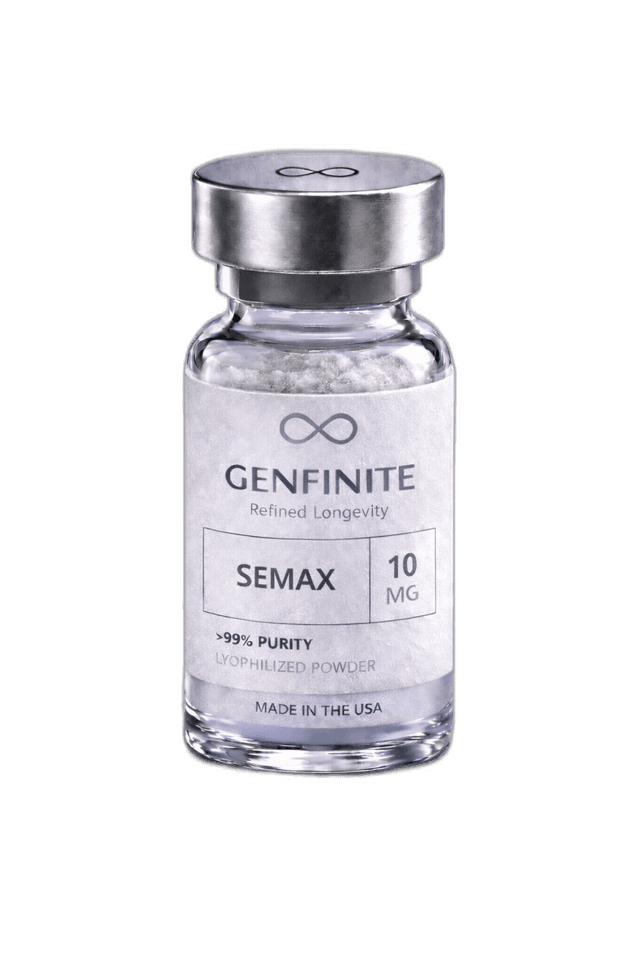
SEMAX and SELANK are two synthetic peptides developed at the Institute of Molecular Genetics of the Russian Academy of Sciences, both registered as pharmaceutical drugs in Russia and Ukraine. Despite their shared origin and overlapping research domains, their mechanisms of action, primary applications, and neurological targets are meaningfully distinct. This article compares their research profiles side by side.
Structural Origins
SEMAX is a heptapeptide (Met-Glu-His-Phe-Pro-Gly-Pro) derived from a fragment of adrenocorticotropic hormone (ACTH 4-10), with a proline-glycine-proline extension added to enhance metabolic stability. Unlike the full ACTH molecule, SEMAX does not activate adrenal steroidogenesis — its activity is confined to the central nervous system.
SELANK is also a heptapeptide (Thr-Lys-Pro-Arg-Pro-Gly-Pro), derived from the immunoregulatory tetrapeptide tuftsin, with the same PGP stability extension. Its structural core confers both immunomodulatory and neurological activity — a dual profile that distinguishes it from SEMAX.
Primary Mechanisms: Where They Diverge
SEMAX's most documented mechanism involves upregulation of neurotrophic factors, particularly BDNF (brain-derived neurotrophic factor) and NGF (nerve growth factor). Dolotov et al. (2006) demonstrated significant BDNF elevation in the hippocampus and frontal cortex following SEMAX administration in rats, with the effect persisting beyond the peptide's estimated half-life — suggesting downstream gene expression changes rather than direct receptor binding alone.
SELANK's primary documented mechanism is modulation of GABAergic neurotransmission. Zozulya et al. (2001) demonstrated that SELANK produced anxiolytic effects in rodent models comparable to the benzodiazepine phenazepam, but without respiratory suppression, motor impairment, or withdrawal syndrome — properties consistent with a GABAergic modulator that does not act directly at the benzodiazepine binding site.
Both peptides modulate monoamine neurotransmitter systems — serotonin, dopamine, and noradrenaline — but the emphasis and direction of these effects differ between compounds and across experimental models.
Cognitive and Neuroprotective Research: SEMAX
SEMAX has been most extensively studied in the context of stroke recovery and neurological rehabilitation. Gusev and Skvortsova (2000) conducted early clinical observations suggesting SEMAX may accelerate neurological recovery in ischemic stroke patients, with improvements in motor function and cognitive recovery metrics. This research supported its registration as a pharmaceutical in Russia.
At the cellular level, SEMAX has been shown to protect neurons against oxidative stress and ischemic insult in vitro and in vivo, partly through BDNF upregulation and modulation of apoptotic pathways. Its effects on optic nerve protection in glaucoma models and potential applications in neurodegenerative research have been noted in the literature.
Anxiolytic and Immunomodulatory Research: SELANK
SELANK's research profile centers on anxiety reduction and stress response modulation. Semenova et al. (2010) demonstrated that SELANK normalizes elevated anxiety states in rodent models without the sedative or amnesic effects associated with conventional anxiolytics. Its effect on enkephalin metabolism — specifically reducing the activity of enkephalin-degrading enzymes — has been proposed as a contributing mechanism.
The tuftsin component of SELANK contributes an immunomodulatory dimension not present in SEMAX. Research has documented SELANK's ability to modulate cytokine expression, including interleukin profiles, and to influence lymphocyte activity — positioning it as a compound of interest in psychoneuroimmunology research where anxiety and immune function intersect.
Administration and Pharmacokinetics
Both peptides are administered intranasally in clinical and research settings, which allows for direct entry into the CNS via olfactory pathways while bypassing first-pass hepatic metabolism. Intranasal delivery results in rapid CNS exposure within minutes of administration in animal models.
As peptides, both are subject to enzymatic degradation into their constituent amino acids, which are then cleared through standard metabolic pathways. The PGP extension in both molecules provides resistance to common peptidases, contributing to their relative stability compared to shorter peptide fragments.
Research Disclaimer: This article is intended for educational and research purposes only. All findings referenced are from published preclinical, in vitro, or animal studies. Results observed in laboratory models may not translate to human outcomes. Nothing in this article constitutes medical advice. Genfinite products are sold strictly for scientific research use only and are not intended for human consumption.
References
- 1.Dolotov OV, Karpenko EA, Inozemtseva LS, et al. Semax, an analog of ACTH(4-10) with cognitive effects, regulates BDNF and trkB expression in the rat hippocampus. Brain Research. 2006. DOI: 10.1016/j.brainres.2006.04.016 PubMed: 16730339
- 2.Zozulya AA, Nezavibathko VN, Rjasina TV, Ashmarin IP. Investigation into the anxiolytic effects of SELANK, a synthetic analogue of tuftsin fragment. Bulletin of Experimental Biology and Medicine. 2001. PubMed: 11702190
- 3.Semenova TP, Kozlovskii II, Zakharova NM, Kozlovskaia MM. Experimental optimization of Selank therapeutic effect. Eksperimental'naia i Klinicheskaia Farmakologiia. 2010. PubMed: 20977015
- 4.Gusev EI, Skvortsova VI. Brain Ischemia. Moscow: Meditsina. 2001.
- 5.Meyerson BA, Linderoth B. Mode of action of spinal cord stimulation in neuropathic pain. Journal of Pain and Symptom Management. 2006. DOI: 10.1016/j.jpainsymman.2005.12.009 PubMed: 16484074
- 6.Uchakina ON, Uchakin PN, Miasoedov NF, et al. Immunomodulatory effects of selank in patients with anxiety-asthenic disorders. Zhurnal Nevrologii i Psikhiatrii. 2008. PubMed: 18626455