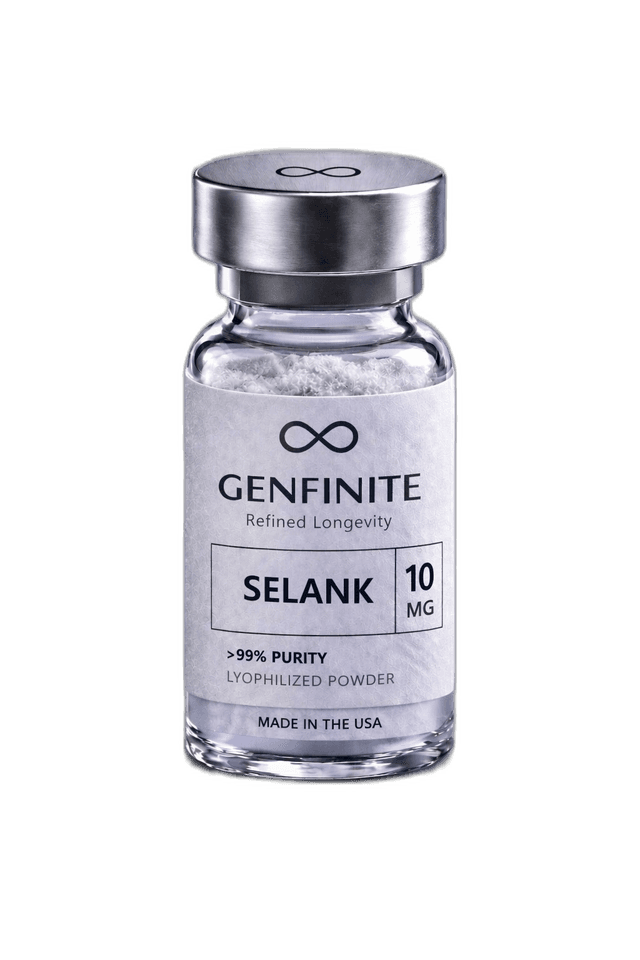
Anxiety disorders represent one of the most prevalent classes of psychiatric conditions globally, and the pharmacological tools available for their treatment carry significant limitations — benzodiazepines produce tolerance, dependence, and cognitive impairment; SSRIs require weeks to achieve effect; buspirone has modest efficacy. Against this backdrop, the research profile of SELANK — a synthetic tuftsin analog — has attracted scientific interest for its apparent ability to modulate anxiety through GABAergic pathways without the liability profile of classical anxiolytics.
The GABAergic System and Anxiety
Gamma-aminobutyric acid (GABA) is the primary inhibitory neurotransmitter in the mammalian central nervous system. GABA-A receptors — ligand-gated chloride channels — mediate rapid inhibitory neurotransmission throughout the brain, and their modulation is central to the mechanism of benzodiazepines, barbiturates, and general anesthetics.
Benzodiazepines act as positive allosteric modulators of GABA-A receptors at the benzodiazepine binding site, enhancing chloride influx in response to GABA and producing their anxiolytic, sedative, anticonvulsant, and muscle-relaxant effects. Chronic use produces tolerance through receptor downregulation and subunit changes, and abrupt discontinuation can produce a severe withdrawal syndrome.
SELANK's GABAergic Activity
Early research established that SELANK's behavioral effects were partially blocked by flumazenil — a benzodiazepine receptor antagonist — suggesting involvement of GABA-A benzodiazepine-site signaling. However, SELANK does not directly bind the benzodiazepine site with high affinity in receptor binding assays, indicating an indirect or modulatory mechanism rather than direct receptor agonism.
Proposed mechanisms include enhancement of endogenous GABA release, modulation of GABA uptake transporter activity, and indirect potentiation of GABA-A receptor function through associated signaling pathways. The net effect — reduced excitatory tone and increased inhibitory signaling — is consistent with the observed anxiolytic profile.
Preclinical Evidence for Anxiolytic Effects
Zozulya et al. (2001) conducted a systematic comparison of SELANK against phenazepam (a potent benzodiazepine) in multiple rodent anxiety models including the elevated plus maze, open field, and conflict tests. SELANK produced comparable anxiolytic effects to phenazepam in all models at appropriate doses, without inducing sedation, motor impairment, or memory deficits.
Importantly, repeated administration of SELANK in these models did not produce the tolerance or withdrawal responses observed with phenazepam, suggesting a different neuroadaptive profile — a finding that has been replicated across multiple studies.
Semenova et al. (2010) extended this work to stress-induced anxiety, showing that SELANK normalized HPA axis hyperactivity in stressed rodents — reducing elevated corticosterone levels and anxiety-like behavior — through a mechanism distinct from direct glucocorticoid receptor modulation.
Enkephalin Metabolism and Opioidergic Interaction
A secondary mechanism of interest involves SELANK's effects on enkephalin metabolism. Enkephalins are endogenous opioid peptides with anxiolytic and mood-regulating properties, but they are rapidly degraded by enkephalinase enzymes. Myasoedov et al. (2010) demonstrated that SELANK inhibits enkephalin-degrading enzymes, increasing the half-life of endogenous enkephalins and potentially contributing to its anxiolytic effect through an opioidergic mechanism.
This multi-pathway activity — GABAergic modulation combined with opioidergic potentiation — may explain the robustness of SELANK's anxiolytic effect and its resistance to tolerance, since it does not rely on a single receptor population that can be downregulated.
Cognitive Effects: Absence of Impairment
A critical distinction between SELANK and benzodiazepines in preclinical research is the absence of cognitive impairment. Where benzodiazepines consistently impair spatial memory, working memory, and learning in rodent models, SELANK at anxiolytic doses has not produced these deficits — and in some studies has shown mild pro-cognitive effects, particularly in tasks dependent on attention and working memory.
This dissociation between anxiolytic efficacy and cognitive impairment is mechanistically consistent with SELANK's indirect GABAergic activity. Direct GABA-A receptor potentiation by benzodiazepines produces broad inhibitory effects that impair hippocampal memory consolidation; a more selective modulation of GABAergic tone may preserve cognitive function while still reducing pathological anxiety.
Research Disclaimer: This article is intended for educational and research purposes only. All findings referenced are from published preclinical, in vitro, or animal studies. Results observed in laboratory models may not translate to human outcomes. Nothing in this article constitutes medical advice. Genfinite products are sold strictly for scientific research use only and are not intended for human consumption.
References
- 1.Zozulya AA, Nezavibathko VN, Rjasina TV, Ashmarin IP. Investigation into the anxiolytic effects of SELANK, a synthetic analogue of tuftsin fragment. Bulletin of Experimental Biology and Medicine. 2001. PubMed: 11702190
- 2.Semenova TP, Kozlovskii II, Zakharova NM, Kozlovskaia MM. Experimental optimization of Selank therapeutic effect. Eksperimental'naia i Klinicheskaia Farmakologiia. 2010. PubMed: 20977015
- 3.Myasoedov NF, Shakova FM, Grivennikov IA. Semax and Selank — neuropeptides with nootropic and anxiolytic activity. Biochemistry (Moscow) Supplement Series B. 2010.
- 4.Uchakina ON, Uchakin PN, Miasoedov NF, et al. Immunomodulatory effects of selank in patients with anxiety-asthenic disorders. Zhurnal Nevrologii i Psikhiatrii. 2008. PubMed: 18626455
- 5.Costa E, Guidotti A. Diazepam binding inhibitor (DBI): a peptide with multiple biological actions. Life Sciences. 1991. PubMed: 1675316